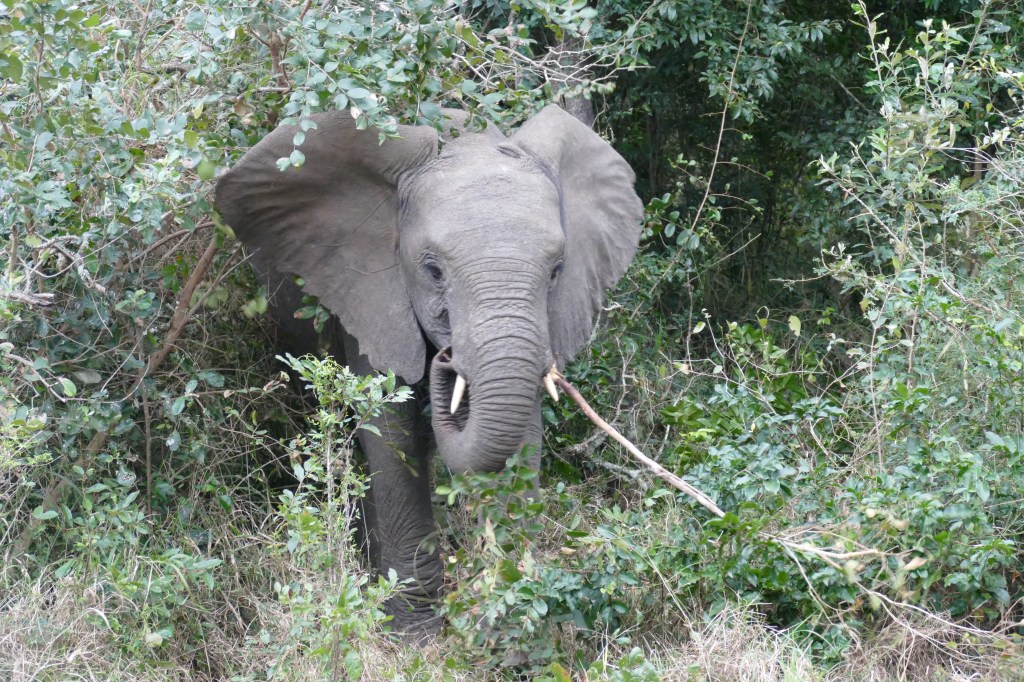
Big feet, big ears, a long trunk, and a body that can weigh up to 12 U.S. tons (11 tonnes): elephants are big. You wouldn’t think that it would be hard to find a herd of elephants on a flat landscape.
You would be wrong.
Finding a herd of elephants can take a long time, a team of people, skills, experience, knowledge, and luck. Why? How can these enormous animals hide in plain sight, and what does it take to find them?
First of all, elephants are quiet. Very quiet. They are so quiet that a large bull (a male) can be walking 30 yards or meters behind you without letting you know it is there. They are so quiet that you might be driving down a dirt road and suddenly see an elephant appear in front of you as if by magic. If you don’t hear them pulling at leaves, branches, and vines while eating, you probably won’t hear them at all.
Elephants have excellent senses of hearing and smell. They know when you are coming, especially if you are in a vehicle. If they don’t want to be around when you arrive, they won’t be. Although your arrival might be annoying or frightening to the herd, depending on its experience with people and vehicles, you are not likely to surprise an elephant or a herd. They may be hard to find because they want to be hard to find.
Elephants are clever animals who know where to hide. If they don’t want you to be near them they will disappear. A tree may look too small to hide an elephant, but its colors and position will allow the animal to dissolve into the foliage. Only a very sharp and focused human eye will catch its presence. If the brush is thick, elephants that are only a few meters away become invisible.
Elephants can also travel long distances in relatively short periods. You can locate a herd through satellite technology if a herd member is collared, but by the time you reach the group it may have traveled far into the bush.

 Conserve Our World